
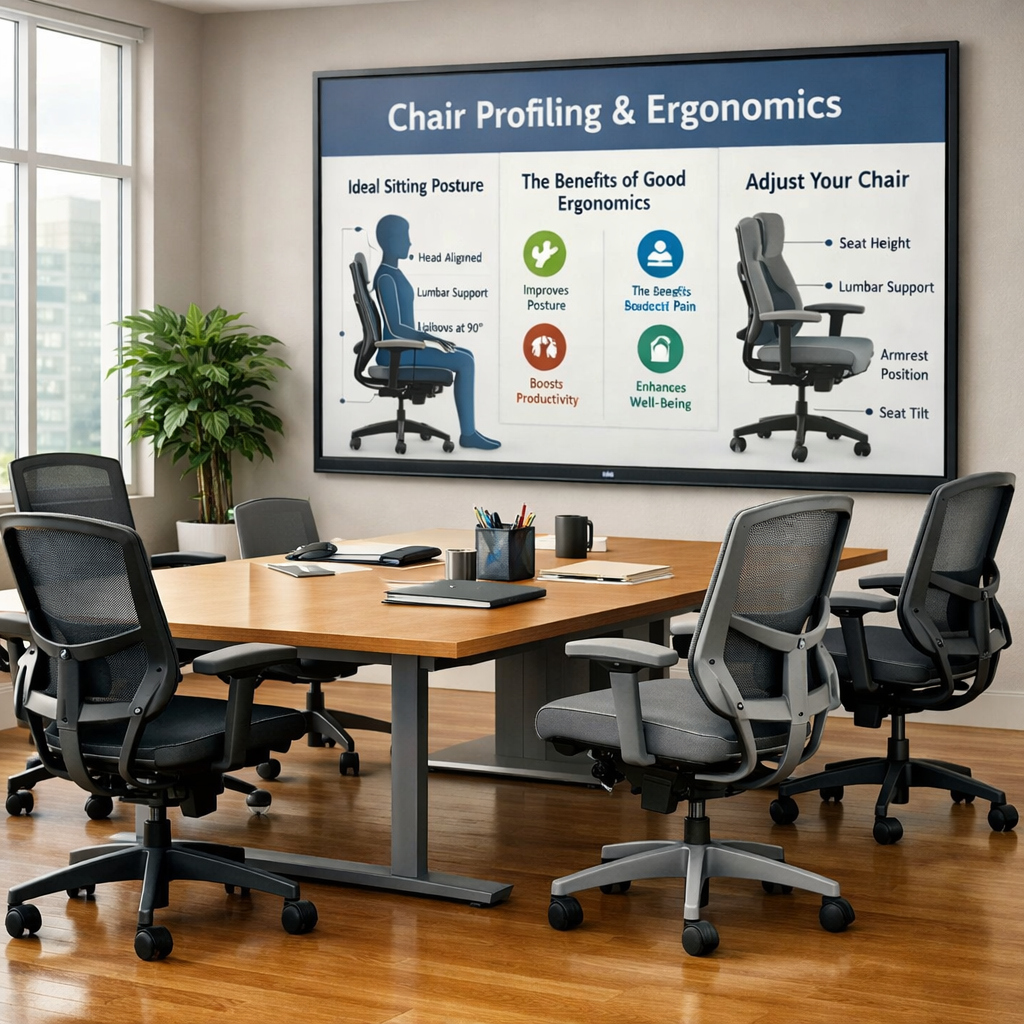
 A reflection on chair profiling, the WIETA CASp program, and why the right framework changes everything.
For the past several years, I’ve been deeply committed to advancing my ergonomics expertise under the teaching guidance and mentorship of Alison Heller-Ono PT, MSPT, CPE in the Worksite International Ergo Training Academy (WIETA). During this time, I’ve completed both the Certified Office Ergonomic Specialist (COESp) and Certified Remote Ergonomic Specialist (CRESp) courses. Each one has sharpened my approach to performing office and remote assessments, report documentation, and client education. I’m now continuing that progression by pursuing the Chair Assessment Specialist (CASp) certification, which will further strengthen my ability to evaluate seating as a system and deliver evidence‑based recommendations.
The Chair Assessment Framework
A critical framework Alison teaches in the Chair Assessment course is “chair profiling”. Chair profiling provides a structured framework for determining how well a chair fits an individual by comparing the user’s key body measurements (anthropometrics), task performance, and sitting behaviors with the chair’s design features and adjustability range. It ensures a data‑driven match between the person and the chair to improve comfort, support, and long‑term ergonomic outcomes. At its core, chair profiling is about applying the right variables to arrive at the right answer. Think of it like a mathematical equation or formula:
Anthropometrics + work style + sitting behaviors = chair adjustability logic + fit range + support strategy
Anthropometrics alone can eliminate a large portion of chairs that simply won’t fit a given person. But the equation doesn’t stop there. Sitting preferences matter enormously because comfort drives compliance. A chair that doesn’t feel right won’t be used correctly, no matter how well it’s engineered.
Every chair also has what I think of as a “personality”, a design logic that shapes how it supports movement, posture, and load. Chair profiling helps match the person to the chair’s personality, narrowing the field to one or two models that will reliably fit without overspending or overengineering the solution.
The result of applying this formula? Recommendations that are evidence‑based, intentional, and tailored to the individual, not guesswork.
The Missing Link
During one of the scheduled check‑ins while completing my CASp coursework, my mentor, Alison Heller‑Ono of WIETA, asked me, “What do you think of chair profiling? Is it helpful in selecting the right chair for someone based on their work style and sitting preferences?”
It’s a deceptively simple question. And the more I think about it, the more I realize how much my answer has evolved. For years, I carried around a collection of fragmented thoughts about chair assessments—instincts built from experience, certifications earned, and patterns I’d observed in the field. The Chair Assessment Specialist (CASp) course finally provided the solidifying framework. The CASp provides a clear, outcomes‑based approach to chair assessment and management, offering professionals in ergonomics, facilities, purchasing, and even chair resellers a consistent, data‑driven method for managing seating assets across their lifecycle.
The anthropometrics taught and applied throughout all three WIETA courses became the evidence‑based backbone that made everything click into place. The CASp didn’t just add more information; it organized what I already knew into a coherent, repeatable framework. It became the missing link that tied all three certificates together and allowed me to see the bigger picture.
When it comes to office ergonomics, everything truly starts with the chair!
Who would benefit from this knowledge?
Facility Managers, Safety Professionals, Chair vendors, and resellers stand to benefit enormously from completing the Chair Assessment Specialist (CASp) course and using the Chair Assessment System (CAS) software, which is included with the course (or available separately). This isn’t just an ergonomist’s toolset; it’s a business advantage for corporations that value employee wellbeing.
The CAS software helps with inventorying, evaluating, and tracking chair assets for quality, competency, and sustainability. With its built‑in assessment tools, it becomes more than a database; it becomes a decision‑support system. Chair resellers who use it can speak confidently about fit, function, and lifecycle value rather than relying on generic sales language or manufacturer claims. Together, the CASp credential and the CAS software give resellers and practitioners a distinct professional advantage.
And that’s where the real shift happens. Instead of conversations centered on “Which chair is cheapest?” the dialogue moves to “Which chair is right?” That shift from price to fitment changes everything! It elevates the vendor’s credibility, improves client outcomes, and reduces costly mismatches or returns. It also positions the vendor as a trusted advisor rather than just a product source.
In short, CASp knowledge, combined with the CAS software, doesn’t just help ergonomists; it raises the standard for everyone involved in seating decisions, including chair resellers, facility managers, safety professionals, and ultimately the organizations investing in healthier, more productive workplaces.
Michael Schiller, CUSP, CRM, COESp, CRESp, CASp (WIP)
President and CEO


Comments